Electricity industry urged to act as growing voltage spikes affect millions of customers

Data gathered from smart chargers operated by EV specialist Ohme suggests more than 10% of UK consumers are experiencing excess voltage spikes. And numbers affected could more than double by 2030 unless the UK electricity industry acts to fix the problem, according to Mike Kelleher, Ohme’s Head of Grid Services.
“Customers are often not aware of the problem – but effects can include EV chargers and solar inverters tripping out, together with strain on electrical appliances and excessive energy consumption. In practice, that can mean cars failing to charge when programmed to do so, households unable to export and get paid for excess solar energy, plus higher bills.
“We are seeing a steady rise in incidents of over-voltage in our customer base, from 8.5% in Q4 2024, to 10.6% in Q3 2025,” he told the Voltage Matters Forum, where industry members share problems and solutions in relation to grid voltages.
“Assuming our customers are typical and the trend continues, this is equivalent to 3.18 million currently being affected nationally, rising to as many as 7.5 million by 2030.”
Dr Euan Kirkmorris, Senior Technical Advisor at energy regulator Ofgem, confirmed: “High voltages on the distribution network are increasingly causing disconnections of devices such as EV chargers and PV inverters, impacting the operation of existing devices and potentially limiting their rollout.”
Mr Kelleher added: “Until now, there has been very little visibility of the immense pressures building up at the edges of networks from millions of new devices are being connected to the grid. The data from our charger network delivers unprecedented insights to understand these pressures and identify the right solutions.”
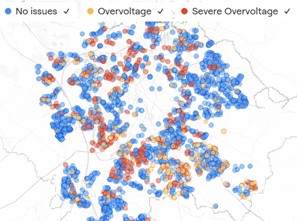
Data from Ohme’s EV chargers suggests more than 10% of UK customers experience over-voltages in a typical week.
Dr Jon Hiscock, co-founder of the Voltage Matters Forum and CEO of voltage control specialist Fundamentals, said: “Incidents of over-voltage recorded by Ohme’s EV chargers are the canaries in the coalmine when network voltages are allowed to stray outside regulatory limits. The data they have collected, analysed and shared is backed by increasing evidence of problems with solar inverters, caused by voltage spikes.
“Highly effective technologies to control voltages have already been developed, as the grid adapts to changes in the ways electricity is generated and consumed – but their implementation is fragmentary. The industry is rapidly waking up to the need for a system-wide approach to voltage management.”
Ofgem’s Dr Kirkmorris said there are opportunities to tackle the problem industry-wide in the Electricity Distribution Price Control (ED3)regulatory framework for 2028 to 2033, which controls investments and costs for distribution network operators. This could include funding and incentives for systems and equipment to better manage voltages.
The Voltage Matters Forum was co-created in January 2025 by voltage control specialists Fundamentals and power engineering experts Threepwood Consulting. It has attracted more than 300 representatives and contributors from across the electricity industry, including network distributors, technology providers, equipment manufacturers, consultants and regulators.
The forum meets regularly online (dates here) and the first of a series of in-person events was held in Birmingham in July 2025.
Learn more

- Article
- Other
IEC 61850 Communication / IEC 61131 Programmable Logic Control Application Integration Method and Use Case

- Other
DER integration needs whole-system voltage control to avoid costly grid reinforcement
- Article
- LV Network Control
- Other
How EcoJoule solutions can tackle local EV charging issues

- Article
- Other