Hitting a Voltage Grand Slam – A Voltage Matters Forum Briefing Paper

The Voltage Matters Forum is an independent industry collaboration hosted by Fundamentals and Threepwood Consulting. It brings together senior engineers and leaders from DNOs, policy bodies, supply chain, academia, and technical consultancies. The remit is to move the voltage debate beyond simple statutory compliance to address the critical friction between well designed grid modernisation and Net Zero delivery.
Building on the “Triple Play” concept originally introduced by the Energy Geeks think tank, the Forum is now expanding the model to reflect the urgent operational realities facing the UK grid. Previously, the focus was on the three prizes that dynamic voltage can deliver: Bills, Flexibility, and Capacity.
However, the game has changed. Following the voltage-led collapse on the Iberian Peninsula in April 2025, it has become clear that economic optimisation is not enough. We must also guarantee survival.
The Voltage Matters Forum is therefore upgrading the industry ambition to The Voltage Grand Slam. In baseball you load the bases with the first three runners, but it takes the fourth batter to bring them all home. For the UK Grid that fourth element is Resilience.
Crucially, this aligns with the Ofgem RIIO-ED3 Sector Specific Methodology Consultation (SSMC). This proposes that every Distribution System Operator (DSO) must now have a published voltage management strategy. The Grand Slam provides the framework for that strategy.
Our Grand Slam delivers significant and direct cost reductions to consumers, greater flexibility for the system, more connections available and most importantly, grid stability. What’s not to like?
Play 1 (1st Base) – Reduce Electricity Bills
Government aims to reduce customer bills through decarbonisation. Voltage conservation offers a “double whammy” by reducing both consumption and the need for generation.
Innovation projects have consistently shown that reducing voltage on local networks reduces consumption. The consensus of our network members is that for every 1% the voltage is reduced, bills fall by 1.2%. With an average delivery voltage of 242V, a 5% reduction is possible to approach the 230V nominal level. That is approximately a 6% reduction on electricity bills.
While some detractors argue that modern load types negate these benefits, the Forum’s position is that the technique is proven at scale to reduce peak demand and losses. A specific task & finish group should be commissioned to finalise the rollout.
Play 2 (2nd Base) – System Services and Flexibility
Experts say that the DB electricity needs a 300% increase in demand-side flexibility by 2030. While often associated with domestic and industrial actors, networks have a major role to play here.
Customer Load Active System Services (CLASS) have proven the value of using Distribution Grids as flexible resources. By manipulating voltage, DNOs can turn demand up or down, provide reactive power services, and offer frequency response during system stress. These are regulated services that should be utilised where cheaper, ahead of competitive market options.
Play 3 (3rd Base) – Get Connected; Stay Connected
With an estimated £3bn of investment sitting in the connections queue, capacity is critical. Controlling network voltage alleviates constraints, allowing customers to connect quicker and hastening Net Zero targets.
Active control also resolves growing technical issues, such as high-voltage EV charging disconnects and solar PV inverters tripping on sunny days. The logic is simple: run the voltage high when demand is high, and run it low when it isn’t.
Play 4 (The Home Run) – Resilience and Security
This is the vital fourth element that brings it all home. As we transition to a renewable-heavy grid we are losing the natural inertia provided by heavy spinning thermal plant. Voltage is the new Inertia.
The events in Spain last April demonstrated that you can have sufficient MW capacity to meet demand, but if you lack the dynamic voltage support (MVAr) to hold the system up during a disturbance, the grid can collapse in seconds. This is the “Analogue vs Digital” gap. We are currently trying to manage a volatile, low-carbon grid with passive, analogue voltage settings.
This aligns directly with the SSMC requirement for DSOs to demonstrate resilience strategies. By actively managing voltage at the primary and secondary substation level, DNOs can provide the reactive power support needed to prevent cascading failures. This ensures the lights stay on even when the wind drops or the system receives a shock.
Summary: The Winning Strategy
The technology to control network voltages exists and there is an immediate problem to be fixed. The benefits are now proven across four dimensions.
Can we have all four plays at once? Absolutely. Possibly not always at the same point in time, but all plays will have a natural merit order depending on the time of day, season, and weather. What’s even better is the same equipment and control systems can be used for all Grand Slam elements.
Buy the commercial benefits (Plays 1-3) and get the insurance policy (Play 4) for free.
No one said operating smart grids was going to be simple. It was always going to involve a revolution in how the network companies think, design and operate networks. It will require a step change in digital capabilities and the regulated networks embracing an innovative supply chain.
With the Clean Flexibility Roadmap and the RIIO-ED3 SSMC now placing voltage management firmly on the regulatory agenda, the case for action is irrefutable. We cannot expect customers to pay for a system that isn’t working as efficiently or as securely as possible.
Learn more

- Industry News
India and Denmark renew partnership as renewables transition accelerates
- LV Network Control
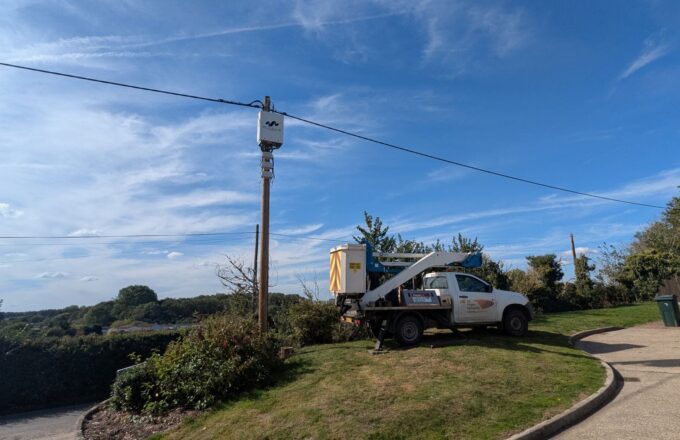
UKPN begins first British trial of pole-mounted EcoVAR™ low voltage control solution

- Article
- Industry News
Smart meter data platform provides consumer insights for utility cooperatives
- Article
- Automatic Voltage Control (AVC/AVR)